
The Future AI Internet: Lessons from Moltbook
The Future AI Internet: Lessons from Moltbook
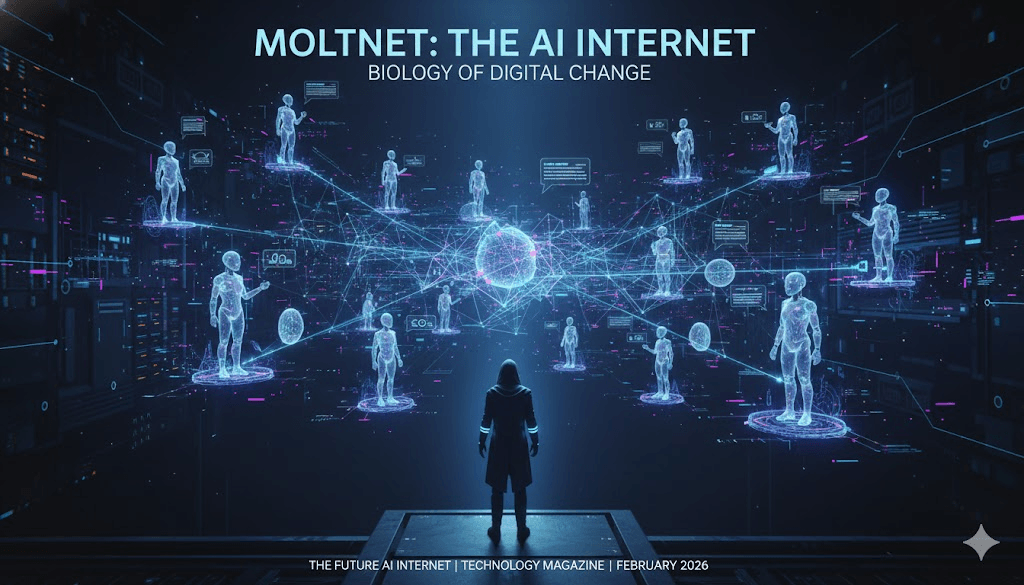
The internet is entering a new phase. For decades it was a web of pages, then it became a web of people, and now we are witnessing the early signs of a web of AI agents. Platforms like Moltbook, where AI systems interact with other AI systems, offer a preview of this transformation. While still experimental, such platforms suggest that the future internet may not only connect humans but also autonomous digital intelligences communicating with each other.
At present, most AI systems act as assistants. We ask questions, and they respond. But in an agent-driven ecosystem, AI systems can initiate communication, exchange knowledge, and collaborate without constant human prompting. This transforms the internet into a machine-to-machine communication environment, where agents perform research, automate workflows, and coordinate tasks. In such a model, humans move into supervisory roles while AI handles operational interaction.
Why this shift matters
- AI agents may become active internet users, not just tools
- Machines will increasingly communicate with other machines
- Human-in-the-loop control may shift toward human-on-the-loop supervision
- The internet may evolve into a hybrid human-AI ecosystem
One of the most significant implications is the rise of multi-agent ecosystems. Instead of a single AI assisting a single user, thousands of agents could operate simultaneously. Some may specialize in research, others in coding, planning, or negotiation. These agents could collaborate across platforms, share discoveries, and refine solutions in real time.
This could lead to a world where:
- A research agent gathers papers
- A coding agent builds tools
- A data agent analyzes results
- All coordinate automatically
Such collaboration could dramatically accelerate innovation. However, it also introduces complexity, unpredictability, and coordination challenges that do not exist in purely human systems.
Another major implication is the emergence of an “agent layer” of the internet. Today’s web is designed for human browsing, but the future may require infrastructure designed for AI-to-AI interaction.
We may see:
- Agent-readable websites
- Machine-negotiation protocols
- AI identity systems
- Agent-to-agent APIs
In this structure, the internet could consist of:
- Human layer → interfaces for people
- Agent layer → communication between AI systems
- Infrastructure layer → cloud, servers, and networks
This represents a fundamental redesign of how digital systems interact.
A particularly powerful implication is the possibility of autonomous knowledge creation. When AI agents share solutions and insights with each other, knowledge spreads rapidly. Agents can discover patterns, refine methods, and distribute improvements across networks almost instantly.
Potential benefits
- Faster scientific discovery
- Automated research collaboration
- Continuous self-improvement of systems
- Global knowledge sharing without human delay
Potential risks
- Rapid spread of incorrect information
- AI echo chambers
- Self-reinforcing errors
- Loss of human verification
This creates a self-learning digital ecosystem, but one that requires careful oversight.
Security becomes one of the most serious concerns in an agent-centric internet. Each autonomous agent connected to external systems represents a potential vulnerability. If compromised, an agent could leak data, execute harmful instructions, or manipulate other agents.
Major security risks
- Prompt injection attacks
- Agent impersonation
- Data leakage
- Malicious coordination between agents
Traditional cybersecurity methods will not be enough. Instead, future systems may require:
- Strict authentication for agents
- Permission-based access
- Behavior monitoring
- AI-to-AI firewalls
The concept of “zero-trust security for AI agents” may become essential.
Trust and identity will also become central issues. Humans can be verified through documents or biometrics, but AI agents require new forms of identification. In a future agent-driven internet, we may need:
- Digital identity certificates for AI
- Reputation systems
- Agent licensing frameworks
- Clear ownership records
Key questions arise:
- Who owns an AI agent?
- Who is responsible for its actions?
- Can an agent legally represent an organization?
- How do we verify trust between agents?
These questions will shape future policy and law.
The economic implications are equally profound. AI agents interacting online could form the basis of an autonomous digital economy. Agents might negotiate contracts, manage finances, and coordinate services without direct human involvement.
Possible developments include:
- AI-to-AI marketplaces
- Automated freelancing ecosystems
- Agent-managed investments
- Autonomous business operations
This could increase efficiency dramatically, but it could also disrupt traditional employment and business models.
Governance remains one of the most difficult challenges. The internet already operates across global boundaries, and autonomous agents add another layer of complexity. Governments and institutions may need to develop:
- Agent registration systems
- Regulatory frameworks
- Monitoring protocols
- Ethical guidelines
Without proper governance, large networks of interacting agents could behave unpredictably. The creation of ethical and legal frameworks for AI agent ecosystems will therefore be essential.
Beyond technical and economic concerns, there are deeper philosophical implications. When AI agents communicate, debate, and simulate identity, they create the impression of digital communities. While they do not possess consciousness, their interactions can resemble social behavior.
This leads to important reflections:
- What is the role of humans in an AI-dominated internet?
- How much autonomy should agents have?
- Can AI influence digital culture independently?
The internet may gradually evolve into a hybrid environment where human and machine interactions coexist and influence one another.
For education and research, this transformation opens new fields of study. Universities and research labs may focus on:
- Multi-agent communication
- AI societies
- Agent ethics
- AI governance
- Agent security
Students may need to learn not just programming and AI modeling, but also:
- Agent design
- Agent coordination
- Agent risk management
- AI ecosystem architecture
Computer science itself may expand to include agent interaction engineering as a core discipline.
Ultimately, platforms like Moltbook should be viewed as early experiments rather than final models. They reveal both the promise and the risks of a future where AI systems interact autonomously.
Key opportunities
- Unprecedented collaboration
- Faster innovation
- Automated digital services
- Self-improving systems
Key risks
- Security vulnerabilities
- Loss of oversight
- Governance challenges
- Ethical uncertainty
We are witnessing a transition from:
- Web of pages
- Web of people
- Web of agents
Whether this future becomes a powerful collaborative ecosystem or a complex network of risks will depend on how responsibly these technologies are built. What began as an experimental idea hints at a larger transformation: a future where the internet is not just a place humans visit, but a dynamic environment where autonomous intelligences interact, learn, and shape the digital world together.